Intercultural Communication - Personal


Hawaii is definitely a melting pot of cultures. I love being surrounded by diversity and having friends of different ethnic backgrounds. So when it came to considering Creighton I have to admit I was concerned about the culture shock. Needless to say, when I arrived here in Omaha and people learned that I’m from Hawaii their initial reaction was “…then what made you want to come all the way out here?”
Back home, I felt comfortable knowing that a lot of us locals were socially accepting. On the day I left the island I was ready to encounter discrimination at some point while I’m out here in the Midwest, as I knew I was going to be in a predominantly white environment. However, it was reassuring to know that I wasn’t going to be the only person coming from Hawaii. College counselors, alumni, and upperclassmen reassured me that Creighton was a good community and I stuck with that instinct. I was surprised to discover a decent population of international students and thought it was great that they are here. I’ve gotten to know a few of them and learn about their backgrounds, which were all interesting.
I could sense that Creighton strives to encourage intercultural relations. I have attended a few events hosted by the Office of Multicultural Affairs and I also joined the International Student Association. Not only have I engaged in learning about ethnic cultures but I have also been open to communication with people from the mainland. Back home, being Caucasian was a minority and here in Omaha it’s vice versa with Asians being a limited population. I’m glad I was able to find some great new friends here from other states and it’s always been fun hanging out together.
I noticed that group polarization tends to occur with certain people but school sponsored social events, retreats, and service trips serve a good purpose in enhancing multicultural acceptance. As mentioned in the definitional blog entry, all of us have our responsibility in order to encourage more intercultural communication. It could help break stereotypes and bring more harmony into the community. An individual can serve as one role model but to represent as a group could make more of a difference.

Intercultural Communication - Application


The FOX show, GLEE ,effectively demonstrates intercultural communication with a cast of high school teens that are ethnically and socially different. The cast features jocks, cheerleaders, and social misfits. They also diversified the group by having Asians, Jews, African Americans, Hispanics, and Caucasians. Each of them come from such different cultural backgrounds and cliques yet they came together and managed to give incredible performances.
There were a couple of episodes that strongly emphasized the boundaries within a social hierarchy. Finn Hudson was the star quarterback for the school but “risked” alienation by getting involved with Glee to share his singing and dancing abilities. Then there’s Rachel Berry, a truly gifted girl who was often bullied by the cheerleaders and football players for being overly obsessive with herself and her dream to be famous. Kurt is an amazing soprano but was picked on by the macho jocks for being gay. Eventually, he later impressed them with his football kicking skills. Basically, the show touched based with the generic stereotypes that exist in a high school environment. Although it’s highly fictional it set an example in breaking group polarization within a social setting and to be more socially and ethnically accepting. In the finale, it shows how individuals can contribute their own ideas and talents to reach a common goal and fortunately for them they managed to win a competition for sectionals.

Intercultural Communication - Definitional

Intercultural communication is defined as “communication between members of different cultures” and culture is a common set of characteristics or a way of life shared by a group of people from generation to generation. Culture is something that is learned. Thus, children of immigrants to the U.S. assimilate better to the American culture as compared to their parents. It may be difficult for others to handle culture shock because they may feel intimidated by a new system of beliefs and practices. Therefore, it is essential to have a better understanding of cultures and the interactions between them to prevent misinterpretations and disrespectful treatment.

There are three effective approaches that have been used to study intercultural communication and they include: the social science approach, the interpretive approach, and the critical approach. The social science approach is the most traditional because it utilizes observation and prediction of human behavior through quantitative methods. The interpretive approach focuses more on the individual’s experience in a qualitative way. The objective is to understand rather than to predict the behavior. Alternatively, the critical approach focuses on the power relationships between cultures with a goal to produce change. With these three approaches intercultural communication can be viewed through three perspectives.

Diaspora is one particular concept that has always been studied, as it is a Greek word associated with dispersal or scattering. One historical example would be the Native Americans as they were made of various tribes who relocated throughout America. Studies have also been done with the Jewish, Black Africans, Armenians, and a few Asian nationalities. Scholars have found it interesting on how diasporas contribute to one’s culture. Mainly, a diaspora only occurs when people scatter to at least two places, they are associated with some sort of “homeland,” the individuals have self-awareness of their group, and it occurs over several generations (at the minimum of two generations). As time goes on, means of communication between cultures have been enhanced through technological techniques and other media.

Part of studying cultures includes identifying different types of relationships, values, roles, norms, and nonverbal messages. Ethnocentrism tends to come up from time to time when one has the belief that their culture is considered ideal and then judges the elements of another culture. However, it may not always have a bad connotation. According to Neulip and McCroskey, ethnocentrism allows for patriotism of a central group. Stereotyping is another concept that typically has a negative outlook because it could to racist remarks. On the other hand, it helps predict some general behaviors of another culture and lead to better tolerance. To live in a world of such diversity it is essential to continue to study intercultural communication so that all of us could share the effort in reducing hostility and increase levels of harmony. In a nutshell, every global citizen has the responsibilities of being committed, mindful, unconditionally accepting, concerned for ourselves and others, understanding, ethical, and peaceful.


Mass Communication - Personal


I see mass communication as performing one action that impacts several other individuals and it may not necessarily only be through news broadcasting, newspapers, or magazines. When I came to Creighton I eventually became the “go-to girl” for signs, posters, and t-shirt designs. In the beginning of year I helped a friend campaign to be our resident hall president and made eye-catching campaign posters that got her some votes. These posters must have been effective as she said she heard people would vote for her because they liked her posters and it also helped that she had an open and friendly personality.
Just recently I have been asked to start designing t-shirts for Deglman After Dark events. These t-shirts communicate to others a social event and also represents who Deglman Hall is. By having a person wear such a t-shirt it could help promote better attendance for future social activities. After all, mass communication occurs through different mediums. I personally use various fonts and graphic designing to carry out a message. In the past, I have also designed t-shirts for various organizations and I liked to incorporate their mottos or logos because it presents a strong representation of the organization and could share with the receiver if the organization is suitable for him or her. Just like any other printed shirt, it easily visible to others and can influence an individual one way or another.

Mass Communication - Application

Shut Up & Sing is a documentary that followed the limelight of country singers, The Dixie Chicks. The pop country trio included Natalie Maines, Emily Robison, Martie Magquire. While performing a concert in London, Maines made a statement that she never thought would have strongly impact her and the future popularity of the Chicks. Maines had told the crowd, “we don’t want this war, this violence, and we’re ashamed that the President of the United States is from Texas.” (in reference to Bush and the girls’ home state). From that moment on their fans became highly critical. Eventually radios stopped playing Dixie Chick songs because they did not want to offend any more people or because already offended people demanded that the Chicks’ songs and albums should no longer be promoted… and for what specific reason? The public thought the Dixie Chicks had become disrespectful and unpatriotic while in actuality they simply took a stand to express their own opinion. Although it may have been negative they still showed their support for the troops through their songs but Maines’ statement turned things around.

Through mass communication, what had only been amongst London news quickly made its way back to the United States. It was a chain reaction as the statement was initially made before thousands of people present at the concert, then European media, followed by becoming newsworthy back home. It amazed the Dixie Chicks and their manager on how fast it traveled and how it immediately dropped the status of their country stardom. At the same time, Natalie wasn’t quick to regret what she had said because it was a statement that someone was going to say sooner or later as she had anti-sentiments against the war. The documentary illustrated how the original message filtered through different channels and then impacted thousands of other people.

The Dixie Chicks remained a tight-knit, opinionated group regardless of death threats and diminishing number of fans. They managed to make a comeback and continued to vocalize other messages through their talents, singing songs like “Travelin’ Soldier” and “Not Ready to Make Nice.” Overtime, what once was an outrage back in 2003 had simmered down (or diffused) and the Chicks continue to be genuine people and proud Americans.

Mass Communication - Definitional

Mass communication is just another type of human communication that exists in society today. Every aspect of it is mediated as the audience may or may not be affected by the messaged being carried out by the sender. The sender can be an individual or from several other sources and the message can be deciphered through different perspectives. Popularly associated with mass communication is the media but it is not only limited to them. Time Warner, Disney, News Corporation, Viacom, and Bartelsmann are five internationally known incorporations that utilize the power of mass communication. Other than the audience, the communication experience, and the communicator, limited feedback is another element to consider.
Through the process of the mass communication there are certain responsibilities that belong to a “gatekeeper” a person who is basically like an editor-in-chief and is the one that selects, changes, and/or rejects messages. This person has the power to “influence the flow of information” between sender and receiver. Normally, there may not only be one gatekeeper but a whole network especially when it comes to news media and magazines. It is a highly complex role as there are different limitations or requirements to consider before being able to produce information. Something that is common amongst those in the United States is economics. Thus, advertisements in every shape and form are ubiquitous as companies are always trying to find a way to make more profit. It is also important for the gatekeeper to oblige to legal restrictions, deadlines, and ethics. Competition and news value are other factors that encourage the communicator and the gatekeeper to have strong ties together to get their message across for faster and more effectively.
There are two models of message flow. The Hypodermic Needle Model says, “each audience member receives messages directly from the source of a given medium.” In other words, the message being sent can be so influential that it could become dangerous for the receiver, such as the use of propaganda and Hitler’s tactics. Another model is the Two-Step Flow Model. This consists of information being passed from various mass media to opinion leaders who then pass it on to people within their own population. Opinion leaders are always in frequent communication and are always working on influencing others on a regular basis. Nevertheless, information needs to pass through these models carefully in order for the original sender to make their point. As an outcome, one should remember that the rate of diffusion of information, referring to the travel time through various communication channels and community of receivers.
Overall, each and every one of us is caught up with the latest technology, e-mail, cell phones, social networks, etc. Through the cultivation theory, we are also easily influenced by what we see on TV or hear on the news and it sets a somewhat universal mindset. There is also the mean world syndrome, which causes some people to believe that the world is a cruel place and this belief develops from different sources of media. In a world that copes with the possibilities and pitfalls of technology, mass communication continues to expand, as it is easy to find various mediums to pass the word along and continues to emphasize social norms.

Tubbs, Stewart, and Sylvia Moss. Human Communication. 11th ed. New York: McGraw-Hill, 2008.

Small Group Communication - Application


Game shows are relatively popular TV shows. One show that featured opposing teams was “I Survived a Japanese Game Show.” Two different teams from America fly to Japan and participate in a game show series unless the individual gets terminated from their team and are forced to go back home. The teams work as small groups in order to increase their chances of winning better prizes like Japanese spa treatments versus losing and cleaning a dirty, busy casino. Winning challenges as a team also increased the amount of grand prize money the winning individual wins, as the last one standing.
It seems as if people see entertainment in people humiliating themselves. However, these teams who begin as “small groups” cope with media pressure and peer pressure to carry out each task. The members of these teams could range from being a stay-at-home-soccer-mom to an ultimate athlete or maybe a computer programming guy. These teams also have to think strategically about the person they want to eliminate from their team as it could mean getting rid of the strongest person or keeping them until the final straw. I noticed from the two seasons of the show, there is always a female or male that the entire team and opposing team underestimate. Eventually the underdog comes out on top and it pays off for them. Sometimes, team leaders become overly demanding and other times they are not aggressive enough to help guide the team. This show demonstrates how a small group of different backgrounds somehow learn how to co-exist to reach a common goal in an entirely different country and function under pressure especially with such incentives in mind.

Small Group Communication - Personal


In Thursday’s COM 111 session, Dr. Hatfield got us to get into random small groups to complete a special task. The objective was to communicate effectively in a group and between other groups and create something with miscellaneous household materials that would prevent an uncooked egg from breaking upon being dropped three stories high.
I belonged to the Eggz-ecutives group and I felt as if we were a group that worked well with each other. However, I did have a first impression that we may have some dominating personalities but it actually did not necessarily come down to that. I liked that there was an even ratio of boys and girls and we were able to all have a say in improving the product before being satisfied with our final product. Each of us carried our own share of work and encouraged each other that we have the time and materials to do what we need to do.
I noticed that we reached a compromise in utilizing a parachute and creating a highly cushioned container to hold the egg. I did experience voicing my ideas about something but not being heard the first time around until the group realizes that it was a better idea to begin with. Other than that we still managed to have an effective collaboration and succeeded in saving our egg from any damage.
Being given only 15 minutes to complete the task I was somewhat worried as I was unsure about everybody’s work ethics and ideas. I felt the pressure to get things done and time and not waste any time in overly planning the product. In a group of four, we each naturally assumed the position as a group facilitator so that our product was made efficiently. No one really seemed to self-appoint himself or herself as a leader so it felt more democratic as we each made a contribution. Although some group rivalry existed with the other groups, we focused on our goal and achieved it.
Had we had groups larger than 4 or 5 members it would have been harder to incorporate everyone’s ideas in such a short period of time and an increased likelihood of clashing personalities.

Small Group Communication - Definitional

It is through small groups in which we can expand our physical social network with three or more people, we can teach and learn from others, or we can achieve shared goals. Generally, when working in a group there are different levels of influence depending on individual personalities and total number of members. There will always be people with strong leadership and others who hold back. Festinger’s social comparison theory believes individuals will always be comparing with others in order to make a consensus or a majority versus the minority. In “groupthink” a victim may result in conforming to other people’s ideas and not have their voice be heard. Different levels of creativity also exist. Nevertheless, in times of trouble with these concepts group members would learn to compromise.

A group member has his or her own role. Progress can be made if each member participates and recognizes that each of them is equal to each other. Individuals should also be open to other proposals. For the success of the group as a whole, constant interaction should occur (i.e. bouncing off ideas), members should support each other, and domination should be avoided. Cohesiveness is key in keeping a group together until the final product has been made.

There are four phases in group development: 1) Forming, 2), Storming, 3) Norming, and 4) Performing. Basically a group starts when people are recruited at an initial meeting and decisions are still running through people’s minds about whether or not to stay with the group. In storming, the group begins to get oriented with one another and goals are established. Norming allows the group to figure out what types of leadership, work ethics, activities, and deadlines may work with their group while performing is when the group carries all that they had planned out. Performing is also a stage of great productivity. Part of being a group is also utilizing the best type of network, decision-making, and problem solving for it will always be encountered one way or another. All in all, the effectiveness of a group truly relies on the actions of the group.

Health Communication - Personal

There was something about healthcare that greatly attracted me to the field. At this very moment I am an aspiring pharmacist. Overtime I realized the importance of medicine and healthy habits as I also see the effects of illnesses take the toll of people I know. My grandpa passed away at the age of 91 due to a stroke and I was probably about seven or eight-years-old at the time. I never really noticed his old age or his progress of developing a stroke as he always managed to keep up with me when we go for walks outside or whenever he played a game with me while babysitting my sister and me. Then one day he just could not move as much and would spend most of his days in bed.
I would watch my dad (a medical technologist and experienced clinical worker) draw blood from my grandpa each week for testing and give him medicine to take away aches and pains. When it came to doctor visits, my grandma did not understand the medical lingo that the doctor and nurses presented to her and always relied on my dad to translate it in simpler terms and in the Filipino language. Then before I know it I could not even speak to my grandpa in English, he managed to say some gibberish then couldn't speak at all. I was too young to understand what was happening to him. However, I still remind the precautions that my family took to help my grandparents out. It involved gathering more information about what was wrong with my grandpa, have him visit the doctor, which eventually turned into a more prolonged hospital stay. My parents wanted my sister and I to keep our distance in case it was a contagious disease until they learned it all had to do with my grandpa, his old age, the worsening of his diabetes, and blood clotting in his brain. Doctors did their best to keep my grandma informed about what was happening and slowly preparing her for the loss of her husband.
One thing about health communication for some professionals is being able to keep your emotions at bay. However, there are also times when they feel empathetic. After such an experience my family learned how to cope with death of a loved one and to continue to live healthier lives not only physically but emotionally, but I think it still gets to my grandma. Needless to say, the health communication models were applied in a way that my family changed our eating habits to lessen our chances of getting diabetes right away in life and to be more physically active because we were influenced by the loss of my grandpa and the advice given by our doctors in order to prolong our own health.

Health Communication - Application


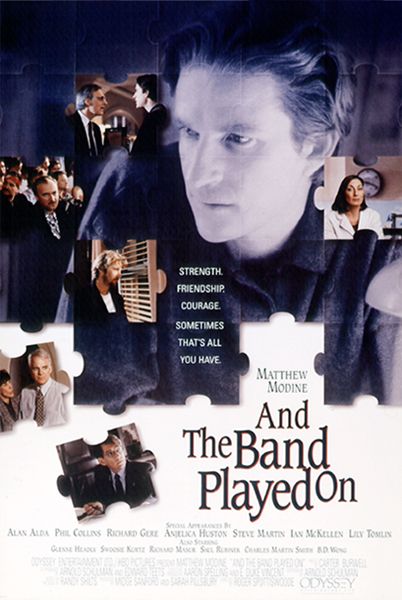
“And the Band Played On” is a 1993 film that demonstrated the reaction of healthcare professionals and the general public to the very beginning of the AIDS outbreak. A prologue scene shows American epidemiologist, Don Francis, and a team from the Centers for Disease Control and Prevention (CDC) discovering Ebola fever in the Congo. It was a scene that spoke for itself lacking much dialogue between characters. Francis and a colleague find themselves in a village flooded by rain and dead bodies from the sick just lying around including the doctor. Through facial expressions and body language it hurt Francis to burn the dead bodies in a bon fire and realizing the effects of Ebola hemorrhagic fever. There was also a scene in which one of the village women spoke out in gibberish then tightly grasped onto Dr. Francis as if to say that she has suffered enough and was glad that someone has showed up to be at her side as her life was slowly ending. These first few scenes set the overall mood for the rest of the mood marking any unknown disease as silent and deadly as people remain ignorant.
Starting in the 1980s, cases came up in which people were dying of an “unknown” disease until a pattern was noticed it was occurring amongst gay men. This caused the disease to be called Gay-Related Immune Deficiency (GRID). As the CDC began to think it originated in bathhouses it then led to the idea that the disease is sexually transmitted. Based on the Theory of Planned Behavior, more people began to see gays in a condescending way and brought about an uproar in the gay community. People would avoid gays thinking that any contact with them would get themselves sick as being gay was already against the given “norms.” However, the CDC realized not every symptom of the disease could be physically observed.
As the number of cases rose from the hundreds to the thousands, the public demanded an answer. Although the disease was killing more and more people it was not highly publicized in the media because it did not have an official name and the CDC was still trying to learn how it came about. Part of their discoveries was that it also occurred in women. This drastically changed the outlook of the disease. There were certain questions that the CDC had to survey people and they pertained to highly sensitive topics such as one’s sex life. Therefore, it may have caused some awkward communication between genders at a professional level. Nevertheless, it contributed to health communication to figure out the disease.
Dr. Francis and the CDC team brought more information to the table at meetings including relation to the model of feline leukemia and the theory of being transmitted via blood. Once it was labeled AIDS (Acquired Immune Deficiency Syndrome) it got everyone into a panic because it meant that it did not just target gays or males but it could happen to anyone. Overtime, doctors did not know how to treat the illness and as more information was being discovered medical staff like nurses would even quit because they did not want to treat AIDS patients. The way information about AIDS was being uncovered affected how the public reacted to it. Since it was something that could not be recognized or treated right away it left people feeling greatly concerned, precautious, and scared while others remained ignorant and did not realize the effects of the disease simply because terrible symptoms were not occurring with them such as the gay flight attendant.
In order to progress with effective health communication, a lot of information is expected out of healthcare professionals. The average Joe relies on professionals to verbalize the situation they’re undergoing whether they are diagnosed with cancer or if they tore their ACL. At the same time, professionals become affiliated with organizations to help spread awareness within the local community in regards to different diseases or special services for disease prevention. “As the Band Played On” showed the stress involved in organizational communication especially with competitive scientists like Dr. Gallo who demonstrated the “tough-guy-macho” culture. In the ends, the efforts of the CDC and other health officials are appreciated because they help each and every one of us live a life worth living.

Health Communication - Definitional


Health communication allows important ideas and information to be exchanged between healthcare professionals and the general public. It promotes awareness and disease prevention. Several theories and models have been adapted to fit within health communication to provide a more simplistic look on how and why certain individual behaviors change in relation to a particular health situation.

Two most commonly used models include cognitive theories and stage-step theories. One theory is the “Theory of Planned Behavior” or TPB. Ajzen developed it and it focuses on the influence of beliefs and attitudes on a changed behavior. A perceived behavior control also comes into play with the model as a determinant in which the individual contemplates on their ability to assume such behavior. This model follows the intentions of the individual. The other model is the “Health Belief Model” or HBM by Rosenstock. Although it still assesses the change in behavior of an individual it helps make predications based on the individuals vulnerability to the situation. Keywords in using this model include determining how “susceptible” they are to getting an illness or how “severe” are the outcomes. In comparison, this model concentrates much more on the person rather than social influence like the TPB model. With HBM, the person needs an incentive to change their behavior, must realize the risks of not changing, they also should believe in benefits, and have confidence to undergo the change. All in all, these models allow a person to consider the cause and effect of certain health habits they have or in which they lack and then develop an action plan.

Another model used in health communication is the “Transtheoretical Model” (TTM) or Stages of Change Model by Prochaska and Diclemente. It is generally an ongoing cycle, but some steps may last for a longer period time than others. It still illustrates the process of going through a change of behavior but also follows the “readiness” of the person. The models consists of: 1) Pre-contemplation, 2) Contemplation, 3) Readiness to change, 4) Action, 5) Maintaining the change, and 6) Relapse. Getting over the phase of accomplishing each level is entirely up to the individual and the choices he or she makes. As a thought process, a person can easily go back to their old ways or be able to maintain the new change and make it a new behavior.

The “Perceived Behavioral Control” (PBC) or Process of Behavior Change is similar to TTM. The process involves preknowledge, being knowledgeable, approving, intending, practicing, and advocating. However, it is not a cycle it is rather like a staircase model towards a set goal. PBC is helpful towards absolute achievement like getting at least 75% of the neighborhood to use recycle bins and help advocate a community recycling effort.

These various theories and models of health communication are used on a daily basis, sometimes without realization. There are step-by-step processes or a web that identifies how something like a particular health habit or “behavior” had occurred and how it can be changed for the better. Ordinary people and go through these theories to help themselves quit smoking or to stick with a diet. Physicians and other healthcare consultants can reinforce or better advise these individuals before carrying out the next step. It is essential to keep up with health communication as it helps all of us live longer and better lives as well as to prevent future generations from making the same mistakes in looking after their own health.


Corcoran, Nova. "Theories and models in communicating health messages." Communicating Health: Strategies for Health Promotion. Thousand Oaks, CA: Sage Publications Ltd, 2007. 5-31.

Organizational Communication - Personal


Being involved with extra-curricular activities and organizations in high school always kept me busy. Most of the organizations that I was in followed the standard leadership roles with a president, vice president, secretary, treasurer, and parliamentarian. However, there was one particular organization that was a little different. It was the Raising Student Voices and Participation (RSVP) panel. RSVP simply comprised of two faculty advisors, a student leadership team, and facilitators. RSVP is strongly student-based but is still overseen by some faculty for guidance.
The purpose of our organization is to help voice the opinions of our school’s general student body. This allows students who are not likely to be great involved with student affairs an opportunity to speak up about issues with our high school, our community, or our nation. As facilitators we split up into groups of six and go into different classrooms across campus. We would then break the class up and have small group discussions. These little meetings are also known as summits.
I was part of the leadership team made of six members. After each summit we held a meeting with facilitators and the leadership team. The first summit asks students to brainstorm the pros and cons regarding our school, our community, and our nation. Then at the meeting with the leadership team and facilitators we narrow down the results and find out the top three issues that came up. A second summit occurs in the classroom in which action plans are brainstormed and later proposed at the leadership team and facilitators’ meeting. Once the leadership team and facilitators touch base again and we hold a third summit that initiates the action plan and gets our peers involved in making a difference. These meetings demonstrated upward communication and horizontal communication.
With this type of organization, some things can go well and other times not. There were times when some students would not cooperate with their student facilitator or perhaps they would give ridiculous answers. Nevertheless, we use verbal communication in order find out what changes other students (our peers) truly want to happen. One of our successful projects was improving student dress tops because it was a school wide policy to wear a standardized top. Since many students did not like the design teachers sent many of them were sent to the office for going against the policy and teachers have said this delays their lesson plan. Through RSVP summits, we the facilitators and the leadership team made a student effort to change the designs and colors so that dealing with the students who don’t wear the dress top will no longer be an issue. The following school year, the new t-shirts (and their different variations) were sold out and more students consistently wore the uniforms. It was a challenge but it was a good starter project for RSVP especially with a public school of about 2,000 people. Organizational communication came into play and was effective in carrying out a satisfying, final product.

Organizational Communication - Application

On October 13, 2009, KnG “Kicks ‘n’ Giggles” Station was founded. As a group that had interests in entertainment, it inspired us to start a new American TV station that fell into the comedy genre. Our purpose is to provide quality television for the general public through means of comic sitcoms, movies, as well as dramedies. Our goal is to have higher primetime ratings than competing stations and we hope to have a target audience that includes adolescents, teenagers, and adults.
As a new incoming TV station, we have a “bet-your-company” type of culture. We are investing a lot of money in producing various programs but would have to wait for feedback as each show and movie make their premieres on TV. At first we thought we would have a “work-hard-play-hard” culture, as we want to be a fun organization and primarily have satisfied viewers. However, it does take a while to see the correlation between the types of programs we have and the number of viewings. KnG specifically aims to have a good primetime setup, as it is one of the most competitive time slots for television viewing.

A scene from The Office, an NBC sitcom.

Our organization is going to be run by a CEO followed by a Board of Directors and beneath them are supervisors and technicians. Downward communication will take place. However, we will also have representatives to extend horizontal communication across the chain of commands. There will be company meetings and department meetings, which will be open to new product proposals (new show ideas). Teams of technicians will be responsible for the production of their designated show. These teams can take advantage of open proposal meetings as KnG is all about having open-mindedness.
We want to utilize the relational function of communication as it calls for “creating and maintaining business and personal relationships with other members of the organization.” To be able to run a TV station calls for a great amount of team effort. Therefore, we encourage company social events and consistent monthly meetings to ensure that positive relationships can built and so people would feel more comfortable sharing their opinions with others whom they will become more familiar with.
In a case in which a problem may arise there will be a step-by-step procedure before letting go of an individual. From day one, KnG will make sure that the contract with a potential employee is clear and that the individual is aware of their personal role in the organization. Although we support creative freedom there will be guidelines to ensure that the material that KnG produces will be appropriate for our audience and it may be subject to change at any moment based on what would benefit our station in the long run. Nevertheless, conflicts will be handled through proper communication and facilitated by proper authority.

Organizational Communication - Definitional

In an organization, exist several different roles. Effective communication between the roles is essential in order for an organization to thrive. Needless to say, there are a wide variety of communication channels in an organization leading to different messages.

Some fundamentals that an organization should first establish include having a purpose, setting goals, and having a good sense of its “culture” and leadership. Deal and Kennedy are communication scholars who came up with four general types of organizational cultures: “Tough-Guy-Macho,” “Work-Hard-Play-Hard,” “Bet-Your-Company,” and “Process.” The settings of these cultures range from dealing with high risks or low risks and immediate feedback or slow feedback. Altogether having knowledge of these foundations helps set a theme and the desired work environment for any type of organization.

According to statistics, 96% of executives believe in a linkage between communication and productivity. In fact, having communication skills is highly expected out of graduates entering the workforce. It allows for better teamwork and also portrays the effectiveness of leadership within the organization. Conrad’s three communication functions in organizations include command, relationship, and ambiguity management leading to outcomes of coordination, satisfaction, clarity, and explanation. Keeping these functions in mind allow individuals within an organization to relay intended messages more effectively especially when it comes to delegating work or meeting customer needs. It is also critical for individuals at work to consider do I know what is expected of me at work? This mainly has to do with the two-way relationship between leaders and employees in which supportive communication or non-controlling communication is established. This also means building trust based on integrity, sharing control, openness, consistency, and demonstration of concern. These characteristics constitutes to a trusting relationship and effective use of communication for a general organization.

In order to make progress there’s actually different “directions” of communication that make take place. Downward communication is the relay of messages from upper management going down through the chain of command. Unfortunately, this may lead to information overload but scholars have recognized seven ways on how people adapt to it: omission, error, queuing, filtering, approximations, multiple channels, and escape. Unfortunately, these ways may not necessarily mean that the information has been taken into consideration or if has even been fully processed to one’s expectation. Another form of communication is upward communication, which allows for the delivery of messages from lower to higher levels of authority. This means employees can have their voice be heard by supervisors, managers, executives, etc. However, this is not always practiced in every organization as NASA has been used as an example. Nevertheless, upward communication demonstrates a management’s willingness to hear from secondary staff. There is also horizontal communication in which messages flow across levels and it involves task coordination, problem solving, information sharing, and conflict resolution. Through these different forms of communication, an organization is able to keep track of their productivity and ability to delegate work in different departments as they utilize the four functions of horizontal communication and being able to send and receive messages through the chain of command.


Tubbs, Stewart, and Sylvia Moss. Human Communication. 11th ed. New York: McGraw-Hill, 2008.

Nonverbal Communication - Personal Entry

In high school, I was part of the student council. When it comes to meeting with peers and planning things for an entire student body I found it essential to have a good understanding of nonverbal communication. Every month of the school year we always had general meetings with all class councils. With the great amount of people it was helpful that we did a “temperature check” before making decisions. A temperature check requires every individual to raise their whole hand, a fist, or two fingers. A whole hand means “Go ahead. I’m all for it,” a fist means, “I’m putting a stop to it. It's not the great idea,” and two fingers mean “I don't know" or "it doesn’t matter." This system quickly performed a survey before finalizing decisions without having to go around in circles of debate right away. Instead it identifies the people who disagree with the motion in question and opens the floor of discussion. I saw it as an effective democratic process.

Also, part of being in council was sharing ideas. Of course not everyone may like one idea and a compromise had to be reached. There were times in which I sensed some sarcasm between people as one person would try to degrade another person's suggestion. Sometimes, I would see our advisors shake their heads in disappointment that our council meetings were not always being ran productively. Then, there also times when each council member took turns making proposals and people would nod in agreement or acceptance and acknowledge whether they think a particular activity sounded like fun with a smile or a "ho-hum" type of reaction.

Being part of the student council required strong communication skills and it doesn't only include verbal communication. I took notice of nonverbal communication too and it helped me initiate conversations for any concerns individual people may have with something or help certain members feel more comfortable to throw in their own ideas.

Nonverbal Communication - Application Entry


Speak (2004) - A film based on the novel by Laurie Halse Anderson.


Melinda Sardino's life took a sharp turn into a completely different direction after an unpleasant incident that happened at a summer party. Regardless, of what specifically happen it seemed like the rest of the study body shunned her because they thought she called off the biggest bash of the summer. As this teenage girl begins a new school year she cannot find to be her outgoing self. Inside she feels trapped with guilt, shamefulness, and loneliness. The audience will noticed that Melinda presents herself in a cold way, appearing to be precautious of her surroundings, stiff, and reserved. Whenever, she encounters the guy that did the wrongdoing at school she tries to push him off when he gets too close for comfort because he interfered with her personal space. Pushing him off and backing away are forms of nonverbal communication showing uneasiness.
Her art teacher was the only one that gained enough trust from her to have a better understanding of the emotional roller coaster she's experiencing. Other than that, her refusal to speak up then ending up screaming in a closet was just one way she let out a frustration that she had with the world around her and her own life. She eventually turned to art and it helped her become more open and expressive through painting. Art helped Melinda find her "voice" again and later let people know that she was hurt that summer and she did not want it to happen again especially to her best friends who at one point did not believe her. One could see that she was unhappy for a long period of time until she gained the courage to stand up against the guy and feel liberated.

Nonverbal Communication - Definitonal Entry

Nonverbal communication simultaneously occurs while verbal communication is taking place. Messages can vary from verbal/nonvocal, nonverbal/vocal, and nonverbal/nonvocal. Verbal/nonvocal refers to the use of words without any actual speaking. An example of this would be signs like a stop sign or the symbol for men or women on a restroom door. It could also be incorporated on graphic designs that contain words like t-shirts or billboards and banners. Another type of message is nonverbal/vocal in which vocalizations do exist but do not necessarily contribute specific statements such as sighing in boredom or groaning in disagreement. Again, the third type of message is nonverbal/nonvocal, which involves gestures like hailing a cab or a baseball umpire’s hand signals. All in all, these types of messages allow for communication with or without actual speaking and yet use physical movements, sounds, or written text.
Generally, there are three cues for nonverbal communication: spatial, visual, and vocal. There’s always a time and a place for things to occur. In a physical sense, there are only so much people who feel comfortable with someone hovering over their shoulder or speaking to another person closely face-to-face. The interpersonal distance zones vary from intimate distance, personal distance, social distance, and public distance. Timing should also be taken into consideration; a person can be monochronic or polychronic. Though multi-taskers think they are getting more done at the same time they tend to take a lot longer rather than thoroughly focusing on one thing at a time. When it comes to studying visual cues this is when others practice kinesics, “the study of body movements in communication.” Investigators are experts in reading people’s facial expressions and body behavior because it could give away clues on whether the person in question may be guilty or not. It could even come down to noticing even the slightest eye movement or lack of eye contact (also known as oculesics). The way a person dresses can also set a strong impression, which is often why it is important to dress appropriately for things like job interviews. Thirdly, there are vocal cues and the study of “vocal phenomena” is known as paralinguistics. The volume, quality, pitch, and rate of speaking can tell a listener something that may contradict the actual contents of the dialogue. For example, a person may say they are ecstatic but says it in a sarcastic matter. Tones like sarcasm can sometimes be over the heads of some people but those who can recognize it are much more aware of a person’s different tones for saying things.
Altogether, nonverbal communication is like a whole other language that does require spoken words. People react to the unspoken, as much (if not more) to how something is said as to what are the explicit meaning of the words. Misunderstandings can often be clarified if the people involved have the ability to notice and comment on the nonverbal communications in an interaction. People will benefit from learning the range of nonverbal behaviors in order to clarify the often subtle dynamics of the situations they find themselves in. In other words, it can be powerful enough to deceive people and they may not be aware of it. The use of signs, text messages, certain “looks,” etc. are often used and can confuse the receiver of the message. Nevertheless, without nonverbal communication certain things would probably not be able to be presented in a discreet matter and the whole world may be considered too loud and noisy if everything had to be said verbally.

Tubbs, Stewart, and Sylvia Moss. Human Communication. 11th ed. New York: McGraw-Hill, 2008.

Gender Communication - Application Entry


Whale Rider (2002)

Whale Rider is an touching film that demonstrates the different concepts of gender communication. It is primarily about a New Zealand girl, named Paikea (which is actually the name of a legendary male) who has to live up to her grandfather’s high expectations. Her grandfather, Koro, was disappointed that his son had lost his newborn baby boy and was left with a girl. The baby boy was supposed to grow and prepare to become the new chief of their tribe. Also losing his wife, Koro’s son moved on with his life, left New Zealand, and traveled around Europe. He eventually came back to be reunited with Koro and Paikea.

Overtime Paikea gained knowledge of the fate that she was supposed to have. She does her best to be a strong and confident individual and prove her grandfather wrong when it comes to underestimating her. One day as Paikea was watching Koro try and fix an engine, Koro uses the metaphor of the twines making up the engines starting rope, to represent how the ancestors are strong and hold everything together for the Maori. Ironically, the rope breaks in Koro's hands, and he grumbles as he went off to find a new one. Meanwhile, Paikea picks up the rope, re-ties it, and starts the engine with it. She becomes enthusiastic about her accomplishment, but Koro came out and reprimanded her immediately, telling her “…Never do that again.” After that moment there was a look of disappointment on Paikea’s face as she must have expected words of praise from her grandfather.

As it may seem Paikea has a strong admiration for her loving but sometimes cold-hearted grandfather. She never gave up on showing how she has the potential to be a leader as her unknown twin brother could have been. She courageously mounted on a whale and somehow helped it build strength to go back into the ocean after being found lying sickly along the New Zealand shores. Her family and fellow tribe members were astonished to find her missing and instead in the ocean riding the whale in the cold weather and storm like the original Paikea, the first ancestor of the Maori people. This is like a “coming of age” moment as celebrated by Jewish males or at the debuts of young adult females. Though she ended up in the hospital, Koro eventually saw her as a “wise leader” after all that she has done to prove him wrong about her –from her chanting performance to her personal essay and of course, bravely turning into a whale rider.

Young Paikea demonstrated the need to have failures, determination, faith, and hope to be someone that others never thought you could actually be. This is similar to the story of Mulan, in which a once fragile Chinese daughter sacrificed her femininity to become a daring soldier to fight in a war because her father was too ill to do so. These young women put a lot of passion into what they are determined to accomplish in their life and show how there are other sides to the norms that we all abide today.

Gender Communication - Personal Entry

This past summer I applied for a paid internship for Hawaii Pacific Health. I was excited to be exposed to a professional healthcare environment and get paid for it. I distinctly recall prioritizing my department preferences to work for the in-patient pharmacy, the telemetry department, or with administration. After being part of the top 50 out of 200 applicants to be hired, I found out I was going to work in the Facility Management department at Kapi’olani Medical Center at Pali Momi.

“Wait… What department am I in again?” as I tried to verify that I heard correctly. “Facility Management.” In other words, I was put in a department in which I otherwise knew as maintenance… a job that I believe did not suit me well. I wondered how I got placed in such a random department, but I did my best to make the best of it.

The first day on the job came around and I was brought to my department, which turned out to be the hospital’s maintenance shop and security headquarters. I looked around and saw shelves and shelves of all sorts of tools and random parts for any hospital repair. Pretty much all the employees in the department were men in their uniform polos, dark slacks, with walkie-talkies, leather work boots, and their handy-dandy tool carts. The only other female was the secretary of my boss Cory, the Facilities Director. Then, there was me in my business casual outfit, heels, and a padfolio looking as professional as I can be, but I stood out like a sore thumb. The guys pretty told me that they could get a spare polo uniform and I could just wear jeans to work. Being somewhat of a girly-girl that I am I immediately thought why wasn’t a guy assigned to this department? Do they expect me to fix something here?

A couple weeks into the internship program I did a variety of projects. At first I stayed within my comfort zone and helped the secretary process work orders on the computer, file things, answer the phone, and organize the office. The guys in the shop jokingly picked on me wondering if I ever got bored of just sitting there in front of a computer screen. Eventually I decided to show the rest of the department that I am definitely not afraid to try something new or to learn how to fix something. Soon enough I was helping out with building a new locker for the dietician department, staining new wood benches, testing the fire pumps, and learning about circuits. I even helped the security check tags and move bodies from the hospital morgue. I learned the perks of being in Facility Management was being able to have the master key for anywhere in the hospital, knowing how to operate the alarms, knowing the secret hallways and shortcuts, and knowing the security guards got my back. (Haha.) On a more serious note, this department probably gave me an even better experience than I ever thought I would have as compared to the other departments that my new intern friends were working in.

I was still able to take some days off and be able to observe a surgery in the operation room, shadow RNs and pharmacy technicians, and learn about imaging and how to examine an MRI. However, I noticed when I went to these other departments people were always shocked to realize that I am originally work for the facility management department. Of course, society has demonstrated that sort of department is only meant for males. Nevertheless, I learned how to do a lot of practical things and become more “mechanically inclined.” I also learned how to work with the opposite gender and be able to accept their different ways of doing things. I can now impress a family member and a friend or two about things I learned through this internship and show that girls can succeed and benefit from working in that department too, which all in all was a humbling experience that I enjoyed.

Gender Communication - Definitional Entry

Gender communication has a lot to do with biological and psychological aspects. First and foremost, the words “sex” and “gender” cannot necessarily be used synonymously. One’s sex refers to their biological make-up in chromosomes, whereas gender is defined as “the social construction of masculinity and femininity.” To understand gender identity and development specific behaviors of males and females are thoroughly studied and compared to determine the correlation on how they perceive and present themselves as a male or female.

Based on a traditional perspective, it seemed significant for males and females to develop either masculine or feminine traits and have distinct communication behaviors. This of course led to gender stereotyping and sexism in which individuals are discriminated. Some of society’s norms grant that girls should not know more about cars than guys otherwise she is probably a lesbian or a tomboy because knowledge about cars is considered a more “manly” thing. The on the other hand, guys should not be running a pre-school, love interior designing, or do gardening because such activities are too feminine for a guy to be doing. These beliefs have developed overtime by all of us as a society. However, as time progresses, breakthroughs are being made and women are proving that “anything guys can do we can do too” whether it be in sports, construction, or even running a powerful business. Women are no longer being underestimated as much as they use to be back in the day and were only expected to be housewives while the men do all the hard labor. Also, today men can freely demonstrate their talents as amazing chefs, fashion designers, and practice other things that were not accepted when society emphasized being manly for a guy and being feminine for a woman.

An individual experiences gender development through different phases in their lifetime. Though when the individual is just born there are certain motor skills and verbal skills that he or she learns by means of the social learning theory. A male or female would gain knowledge through his or her own observations of a same-sex model within the household or through media. Their gender appropriate behaviors are reinforced by significant others in which any type of praise or punishment helps the individual lay out a foundation of their “gender” for the time being. The Freudian Identification theory later helps the individual be aware of their gender as “society would require of him or her as an adult.” It is believed that males have the fear of retaliation from a figure of higher authority whereas females have the fear of the loss of love. In a typical relationship, most males tend to dislike being confronted by their significant other and it is usually females who like to engage in a much more intimate discussion with their partners. According to a study by Gilligan for the moral voices theory, he concluded that masculinity is defined through separation (especially from their mothers) while femininity is defined through attachment. Females can maintain multiple relationships with girlfriends and boyfriends while males could only attain popular standing with everyone if they have good personal relationships with females. It is as if females are much more analytical of their relationships which tends to relate to the frequency of having “conflicts” and drama with others whereas males can live with individuation and move on with life. These beliefs and observations in behavior contribute to a much more wholesome understanding of gender communication.

Back to Home Back to Top