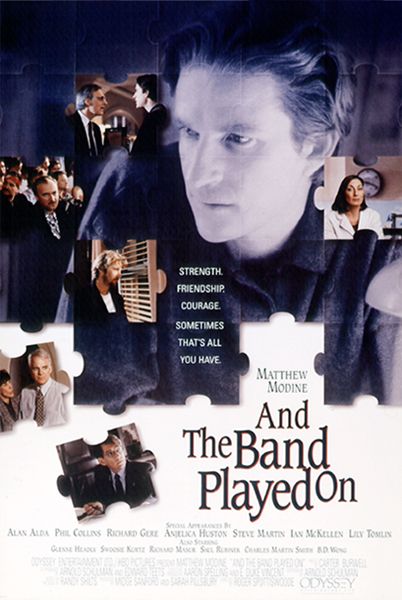
“And the Band Played On” is a 1993 film that demonstrated the reaction of healthcare professionals and the general public to the very beginning of the AIDS outbreak. A prologue scene shows American epidemiologist, Don Francis, and a team from the Centers for Disease Control and Prevention (CDC) discovering Ebola fever in the Congo. It was a scene that spoke for itself lacking much dialogue between characters. Francis and a colleague find themselves in a village flooded by rain and dead bodies from the sick just lying around including the doctor. Through facial expressions and body language it hurt Francis to burn the dead bodies in a bon fire and realizing the effects of Ebola hemorrhagic fever. There was also a scene in which one of the village women spoke out in gibberish then tightly grasped onto Dr. Francis as if to say that she has suffered enough and was glad that someone has showed up to be at her side as her life was slowly ending. These first few scenes set the overall mood for the rest of the mood marking any unknown disease as silent and deadly as people remain ignorant.
Starting in the 1980s, cases came up in which people were dying of an “unknown” disease until a pattern was noticed it was occurring amongst gay men. This caused the disease to be called Gay-Related Immune Deficiency (GRID). As the CDC began to think it originated in bathhouses it then led to the idea that the disease is sexually transmitted. Based on the Theory of Planned Behavior, more people began to see gays in a condescending way and brought about an uproar in the gay community. People would avoid gays thinking that any contact with them would get themselves sick as being gay was already against the given “norms.” However, the CDC realized not every symptom of the disease could be physically observed.
As the number of cases rose from the hundreds to the thousands, the public demanded an answer. Although the disease was killing more and more people it was not highly publicized in the media because it did not have an official name and the CDC was still trying to learn how it came about. Part of their discoveries was that it also occurred in women. This drastically changed the outlook of the disease. There were certain questions that the CDC had to survey people and they pertained to highly sensitive topics such as one’s sex life. Therefore, it may have caused some awkward communication between genders at a professional level. Nevertheless, it contributed to health communication to figure out the disease.
Dr. Francis and the CDC team brought more information to the table at meetings including relation to the model of feline leukemia and the theory of being transmitted via blood. Once it was labeled AIDS (Acquired Immune Deficiency Syndrome) it got everyone into a panic because it meant that it did not just target gays or males but it could happen to anyone. Overtime, doctors did not know how to treat the illness and as more information was being discovered medical staff like nurses would even quit because they did not want to treat AIDS patients. The way information about AIDS was being uncovered affected how the public reacted to it. Since it was something that could not be recognized or treated right away it left people feeling greatly concerned, precautious, and scared while others remained ignorant and did not realize the effects of the disease simply because terrible symptoms were not occurring with them such as the gay flight attendant.
In order to progress with effective health communication, a lot of information is expected out of healthcare professionals. The average Joe relies on professionals to verbalize the situation they’re undergoing whether they are diagnosed with cancer or if they tore their ACL. At the same time, professionals become affiliated with organizations to help spread awareness within the local community in regards to different diseases or special services for disease prevention. “As the Band Played On” showed the stress involved in organizational communication especially with competitive scientists like Dr. Gallo who demonstrated the “tough-guy-macho” culture. In the ends, the efforts of the CDC and other health officials are appreciated because they help each and every one of us live a life worth living.


0 comments:
Leave a Comment