Small Group Communication - Application
Posted in application on byGame shows are relatively popular TV shows. One show that featured opposing teams was “I Survived a Japanese Game Show.” Two different teams from America fly to Japan and participate in a game show series unless the individual gets terminated from their team and are forced to go back home. The teams work as small groups in order to increase their chances of winning better prizes like Japanese spa treatments versus losing and cleaning a dirty, busy casino. Winning challenges as a team also increased the amount of grand prize money the winning individual wins, as the last one standing.
It seems as if people see entertainment in people humiliating themselves. However, these teams who begin as “small groups” cope with media pressure and peer pressure to carry out each task. The members of these teams could range from being a stay-at-home-soccer-mom to an ultimate athlete or maybe a computer programming guy. These teams also have to think strategically about the person they want to eliminate from their team as it could mean getting rid of the strongest person or keeping them until the final straw. I noticed from the two seasons of the show, there is always a female or male that the entire team and opposing team underestimate. Eventually the underdog comes out on top and it pays off for them. Sometimes, team leaders become overly demanding and other times they are not aggressive enough to help guide the team. This show demonstrates how a small group of different backgrounds somehow learn how to co-exist to reach a common goal in an entirely different country and function under pressure especially with such incentives in mind.
Small Group Communication - Personal
Posted in personal on by
In Thursday’s COM 111 session, Dr. Hatfield got us to get into random small groups to complete a special task. The objective was to communicate effectively in a group and between other groups and create something with miscellaneous household materials that would prevent an uncooked egg from breaking upon being dropped three stories high.
I belonged to the Eggz-ecutives group and I felt as if we were a group that worked well with each other. However, I did have a first impression that we may have some dominating personalities but it actually did not necessarily come down to that. I liked that there was an even ratio of boys and girls and we were able to all have a say in improving the product before being satisfied with our final product. Each of us carried our own share of work and encouraged each other that we have the time and materials to do what we need to do.
I noticed that we reached a compromise in utilizing a parachute and creating a highly cushioned container to hold the egg. I did experience voicing my ideas about something but not being heard the first time around until the group realizes that it was a better idea to begin with. Other than that we still managed to have an effective collaboration and succeeded in saving our egg from any damage.
Being given only 15 minutes to complete the task I was somewhat worried as I was unsure about everybody’s work ethics and ideas. I felt the pressure to get things done and time and not waste any time in overly planning the product. In a group of four, we each naturally assumed the position as a group facilitator so that our product was made efficiently. No one really seemed to self-appoint himself or herself as a leader so it felt more democratic as we each made a contribution. Although some group rivalry existed with the other groups, we focused on our goal and achieved it. Had we had groups larger than 4 or 5 members it would have been harder to incorporate everyone’s ideas in such a short period of time and an increased likelihood of clashing personalities.
Small Group Communication - Definitional
Posted in definitional on by It is through small groups in which we can expand our physical social network with three or more people, we can teach and learn from others, or we can achieve shared goals. Generally, when working in a group there are different levels of influence depending on individual personalities and total number of members. There will always be people with strong leadership and others who hold back. Festinger’s social comparison theory believes individuals will always be comparing with others in order to make a consensus or a majority versus the minority. In “groupthink” a victim may result in conforming to other people’s ideas and not have their voice be heard. Different levels of creativity also exist. Nevertheless, in times of trouble with these concepts group members would learn to compromise.
A group member has his or her own role. Progress can be made if each member participates and recognizes that each of them is equal to each other. Individuals should also be open to other proposals. For the success of the group as a whole, constant interaction should occur (i.e. bouncing off ideas), members should support each other, and domination should be avoided. Cohesiveness is key in keeping a group together until the final product h
There are four phases in group development: 1) Forming, 2), Storming, 3) Norming, and 4) Performing. Basically a group starts when people are recruited at an initial meeting and decisions are still running through people’s minds about whether or not to stay with the group. In storming, the group begins to get oriented with one another and goals are established. Norming allows the group to figure out what types of leadership, work ethics, activities, and deadlines may work with their group while performing is when the group carries all that they had planned out. Performing is also a stage of great productivity. Part of being a group is also utilizing the best type of network, decision-making, and problem solving for it will always be encountered one way or another. All in all, the effectiveness of a group truly relies on the actions of the group.
Health Communication - Personal
Posted in personal on by
There was something about healthcare that greatly attracted me to the field. At this very moment I am an aspiring pharmacist. Overtime I realized the importance of medicine and healthy habits as I also see the effects of illnesses take the toll of people I know. My grandpa passed away at the age of 91 due to a stroke and I was probably about seven or eight-years-old at the time. I never really noticed his old age or his progress of developing a stroke as he always managed to keep up with me when we go for walks outside or whenever he played a game with me while babysitting my sister and me. Then one day he just could not move as much and would spend most of his days in bed.
I would watch my dad (a medical technologist and experienced clinical worker) draw blood from my grandpa each week for testing and give him medicine to take away aches and pains. When it came to doctor visits, my grandma did not understand the medical lingo that the doctor and nurses presented to her and always relied on my dad to translate it in simpler terms and in the Filipino language. Then before I know it I could not even speak to my grandpa in English, he managed to say some gibberish then couldn't speak at all. I was too young to understand what was happening to him. However, I still remind the precautions that my family took to help my grandparents out. It involved gathering more information about what was wrong with my grandpa, have him visit the doctor, which eventually turned into a more prolonged hospital stay. My parents wanted my sister and I to keep our distance in case it was a contagious disease until they learned it all had to do with my grandpa, his old age, the worsening of his diabetes, and blood clotting in his brain. Doctors did their best to keep my grandma informed about what was happening and slowly preparing her for the loss of her husband.
One thing about health communication for some professionals is being able to keep your emotions at bay. However, there are also times when they feel empathetic. After such an experience my family learned how to cope with death of a loved one and to continue to live healthier lives not only physically but emotionally, but I think it still gets to my grandma. Needless to say, the health communication models were applied in a way that my family changed our eating habits to lessen our chances of getting diabetes right away in life and to be more physically active because we were influenced by the loss of my grandpa and the advice given by our doctors in order to prolong our own health.
I would watch my dad (a medical technologist and experienced clinical worker) draw blood from my grandpa each week for testing and give him medicine to take away aches and pains. When it came to doctor visits, my grandma did not understand the medical lingo that the doctor and nurses presented to her and always relied on my dad to translate it in simpler terms and in the Filipino language. Then before I know it I could not even speak to my grandpa in English, he managed to say some gibberish then couldn't speak at all. I was too young to understand what was happening to him. However, I still remind the precautions that my family took to help my grandparents out. It involved gathering more information about what was wrong with my grandpa, have him visit the doctor, which eventually turned into a more prolonged hospital stay. My parents wanted my sister and I to keep our distance in case it was a contagious disease until they learned it all had to do with my grandpa, his old age, the worsening of his diabetes, and blood clotting in his brain. Doctors did their best to keep my grandma informed about what was happening and slowly preparing her for the loss of her husband.
One thing about health communication for some professionals is being able to keep your emotions at bay. However, there are also times when they feel empathetic. After such an experience my family learned how to cope with death of a loved one and to continue to live healthier lives not only physically but emotionally, but I think it still gets to my grandma. Needless to say, the health communication models were applied in a way that my family changed our eating habits to lessen our chances of getting diabetes right away in life and to be more physically active because we were influenced by the loss of my grandpa and the advice given by our doctors in order to prolong our own health.
Health Communication - Application
Posted in application on by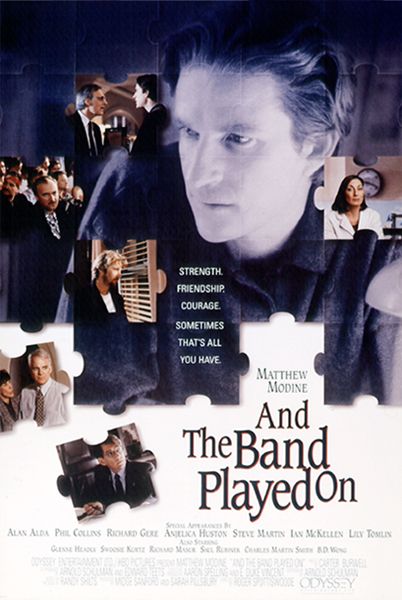
“And the Band Played On” is a 1993 film that demonstrated the reaction of healthcare professionals and the general public to the very beginning of the AIDS outbreak. A prologue scene shows American epidemiologist, Don Francis, and a team from the Centers for Disease Control and Prevention (CDC) discovering Ebola fever in the Congo. It was a scene that spoke for itself lacking much dialogue between characters. Francis and a colleague find themselves in a village flooded by rain and dead bodies from the sick just lying around including the doctor. Through facial expressions and body language it hurt Francis to burn the dead bodies in a bon fire and realizing the effects of Ebola hemorrhagic fever. There was also a scene in which one of the village women spoke out in gibberish then tightly grasped onto Dr. Francis as if to say that she has suffered enough and was glad that someone has showed up to be at her side as her life was slowly ending. These first few scenes set the overall mood for the rest of the mood marking any unknown disease as silent and deadly as people remain ignorant.
Starting in the 1980s, cases came up in which people were dying of an “unknown” disease until a pattern was noticed it was occurring amongst gay men. This caused the disease to be called Gay-Related Immune Deficiency (GRID). As the CDC began to think it originated in bathhouses it then led to the idea that the disease is sexually transmitted. Based on the Theory of Planned Behavior, more people began to see gays in a condescending way and brought about an uproar in the gay community. People would avoid gays thinking that any contact with them would get themselves sick as being gay was already against the given “norms.” However, the CDC realized not every symptom of the disease could be physically observed.
As the number of cases rose from the hundreds to the thousands, the public demanded an answer. Although the disease was killing more and more people it was not highly publicized in the media because it did not have an official name and the CDC was still trying to learn how it came about. Part of their discoveries was that it also occurred in women. This drastically changed the outlook of the disease. There were certain questions that the CDC had to survey people and they pertained to highly sensitive topics such as one’s sex life. Therefore, it may have caused some awkward communication between genders at a professional level. Nevertheless, it contributed to health communication to figure out the disease.
Dr. Francis and the CDC team brought more information to the table at meetings including relation to the model of feline leukemia and the theory of being transmitted via blood. Once it was labeled AIDS (Acquired Immune Deficiency Syndrome) it got everyone into a panic because it meant that it did not just target gays or males but it could happen to anyone. Overtime, doctors did not know how to treat the illness and as more information was being discovered medical staff like nurses would even quit because they did not want to treat AIDS patients. The way information about AIDS was being uncovered affected how the public reacted to it. Since it was something that could not be recognized or treated right away it left people feeling greatly concerned, precautious, and scared while others remained ignorant and did not realize the effects of the disease simply because terrible symptoms were not occurring with them such as the gay flight attendant.
In order to progress with effective health communication, a lot of information is expected out of healthcare professionals. The average Joe relies on professionals to verbalize the situation they’re undergoing whether they are diagnosed with cancer or if they tore their ACL. At the same time, professionals become affiliated with organizations to help spread awareness within the local community in regards to different diseases or special services for disease prevention. “As the Band Played On” showed the stress involved in organizational communication especially with competitive scientists like Dr. Gallo who demonstrated the “tough-guy-macho” culture. In the ends, the efforts of the CDC and other health officials are appreciated because they help each and every one of us live a life worth living.
Health Communication - Definitional
Posted in definitional on by
Health communication allows important ideas and information to be exchanged between healthcare professionals and the general public. It promotes awareness and disease prevention. Several theories and models have been adapted to fit within health communication to provide a more simplistic look on how and why certain individual behaviors change in relation to a particular health situation.
Two most commonly used models include cognitive theories and stage-step theories. One theory is the “Theory of Planned Behavior” or TPB. Ajzen developed it and it focuses on the influence of beliefs and attitudes on a changed behavior. A perceived behavior control also comes into play with the model as a determinant in which the individual contemplates on their ability to assume such behavior. This model follows the intentions of the individual. The other model is the “Health Belief Model” or HBM by Rosenstock. Although it still assesses the change in behavior of an individual it helps make predications based on the individuals vulnerability to the situation. Keywords in using this model include determining how “susceptible” they are to getting an illness or how “severe” are the outcomes. In comparison, this model concentrates much more on the person rather than social influence like the TPB model. With HBM, the person needs an incentive to change their behavior, must realize the r
Another model used in health communication is the “Transtheoretical Model” (TTM) or Stages of Change Model by Prochaska and Diclemente. It is generally an ongoing cycle, but some steps may last for a longer period time than others. It still illustrates the process of going through a change of behavior but also follows the “readiness” of the person. The models consists of: 1) Pre-contemplation, 2) Contemplation, 3) Readiness to change, 4) Action, 5) Maintaining the change, and 6) Relapse. Getting over the phase of accomplishing each level is entirely up to the individual and the choices he or she makes. As a thought process, a person can easily go back to their old ways or be able to maintain the new change and make it a new behavior.
The “Perceived Behavioral Control” (PBC) or Process of Behavior Change is similar to TTM. The process involves preknowledge, being knowledgeable, approving, intending, practicing, and advoca
These various theories and models of health communication are used on a daily basis, sometimes without realization. There are step-by-step processes or a web that identifies how something like a particular health habit or “behavior” had occurred and how it can be changed for the better. Ordinary people and go through these theories to help themselves quit smoking or to stick with a diet. Physicians and other healthcare consultants can reinforce or better advise these individuals before carrying out the next step. It is essential to keep up with health communication as it helps all of us live longer and better lives as well as to prevent future generations from making the same mistakes in looking after their own health.
Corcoran, Nova. "Theories and models in communicating health messages." Communicating Health: Strategies for Health Promotion. Thousand Oaks, CA: Sage Publications Ltd, 2007. 5-31.
Subscribe to:
Comments (Atom)


